


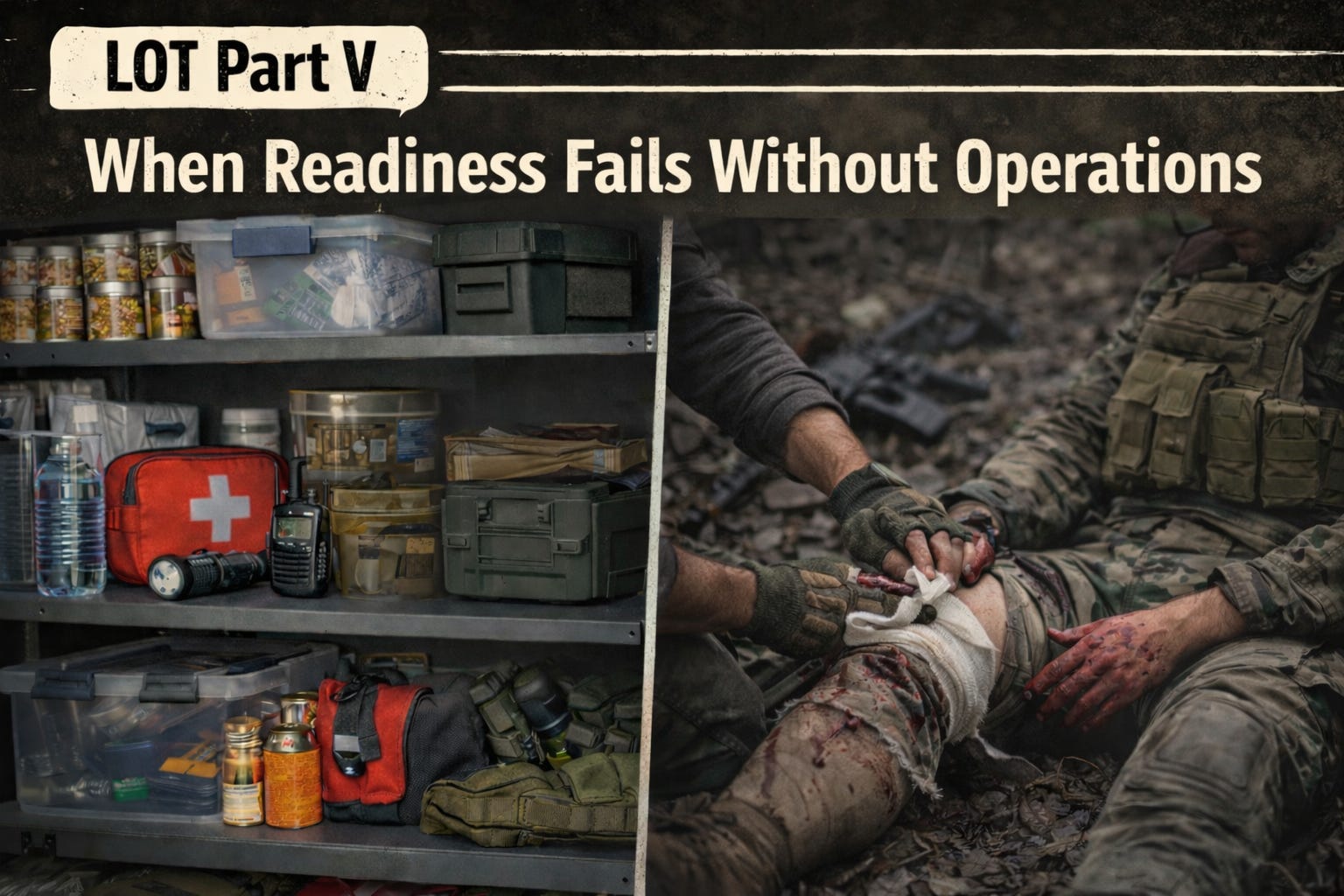
If Logistics is what you have, and Tactical is what you do in the moment, Operations is what turns possession into capability.
This is where most preparedness efforts quietly fail.
Not because people lack gear.
Not because they lack courage.
But because they never built the bridge between supplies and action.
That bridge is “Operations”.
And unlike buying equipment or learning a skill, operations work is invisible when done correctly—so it’s the first thing people skip, and the last thing they realize they needed.
OPERATIONS IS THE MISSING MIDDLE
“LOT” is not a pyramid by accident.
Logistics answers: What exists?
Operations answers: How does it get used, moved, sustained, and coordinated?
Tactical answers: What happens right now?
Most people jump from Logistics straight to Tactical. Operations is overlooked.
They buy gear.
They imagine scenarios.
They practice isolated skills.
What they don’t build is:
• routines
• handoffs
• decision paths
• role clarity
• sustainment logic
• failure handling
That gap is where readiness collapses.
WHY OPERATIONS GETS IGNORED
Operations feels boring because it doesn’t look dramatic.
There’s no adrenaline in:
• labeling bins
• setting resupply triggers
• assigning redundancy roles
• defining authority and decision timing
• planning degradation instead of success
But real crises are not cinematic.
They are administrative stress tests.
When something goes wrong, the people who last longest are not the bravest.
They are the ones who already decided:
• where things live
• who does what
• what happens after the first action
• how long they can sustain before something breaks
That’s operations.
THE READINESS ILLUSION
Preparedness without operations creates a dangerous illusion:
“We’re ready because we have the stuff.”
Readiness is not possession.
It is repeatable performance under stress.
If you can’t answer:
• Who moves supplies if access fails?
• What happens after 24 hours?
• Who tracks consumption?
• Who replaces a downed role?
• When does Plan A end?
• How authority shifts under pressure?
Then your system only works until pressure appears.
OPERATIONS IS WHERE CIVILIANS WIN
You don’t need military force to apply military thinking.
Operations at the civilian level looks like:
• inventory tied to consumption
• rotating roles to prevent burnout
• predefined escalation thresholds
• logistics integrated into daily life
• planning for boredom, not heroics
• systems designed to survive fatigue
This is where professionals train—because they’ve seen failure.
Civilians usually learn the hard way unless they choose to learn early.
WHY TACTICS ALONE DON’T SAVE YOU
Tactical skills matter.
But tactics without operations burn out fast.
You can be excellent at skills and still fail if:
• supplies aren’t where expected
• no one tracks depletion
• authority is unclear
• success breeds overconfidence
Operations prevent success from becoming the next failure.
THE QUIET TRUTH
Readiness doesn’t fail at the moment of action.
It fails between actions.
Between resupply.
Between decisions.
Between shifts.
Between assumptions.
That’s why LOT is a system, not a slogan.
Logistics gives capacity.
Operations gives endurance.
Tactical gives effect.
Remove one, and the system lies to you.
COMING NEXT
Part VI:
Why Tactical Thinking Without LOT Creates False Confidence — And How to Fix It Before It Costs You.
Great information to remind us all , thanks
Damn brother your spot on. The most boring job I had in the army was doing operations in a combat zone. However, I knew it had to be done as it was the "keystone" to mission accomplishment or failure.
That is why the team leader ALWAYS is checking the supply of ammo, water and food on the team especially ammo during a firefight. Most teams train to let their team led know the status of their ammo, GREEN [GOOD], YELLOW [HALF EMPTY] BLACK [OUT]. The latter is not what you want to be calling out.
Those same colors are used for status of water and food as well.
Most dont like operations because 1 it is boring 2. It means they actually have to do mental work. In operations one had to be able to make snap decisions on what information they have, to being able to "think outside the box", i.e. foresee or anticipate potential problems that might arise and make contingency plans for those potential problems. And 3. They have to be able to make split second decision on the fly with very little to no warning and how to make that ball get rolling to the contingency plans into action to rectify or better yet prevent those problems starting or getting larger and out of hand
Another great article awesome work and important information.
Another awesome article brother keep em coming