


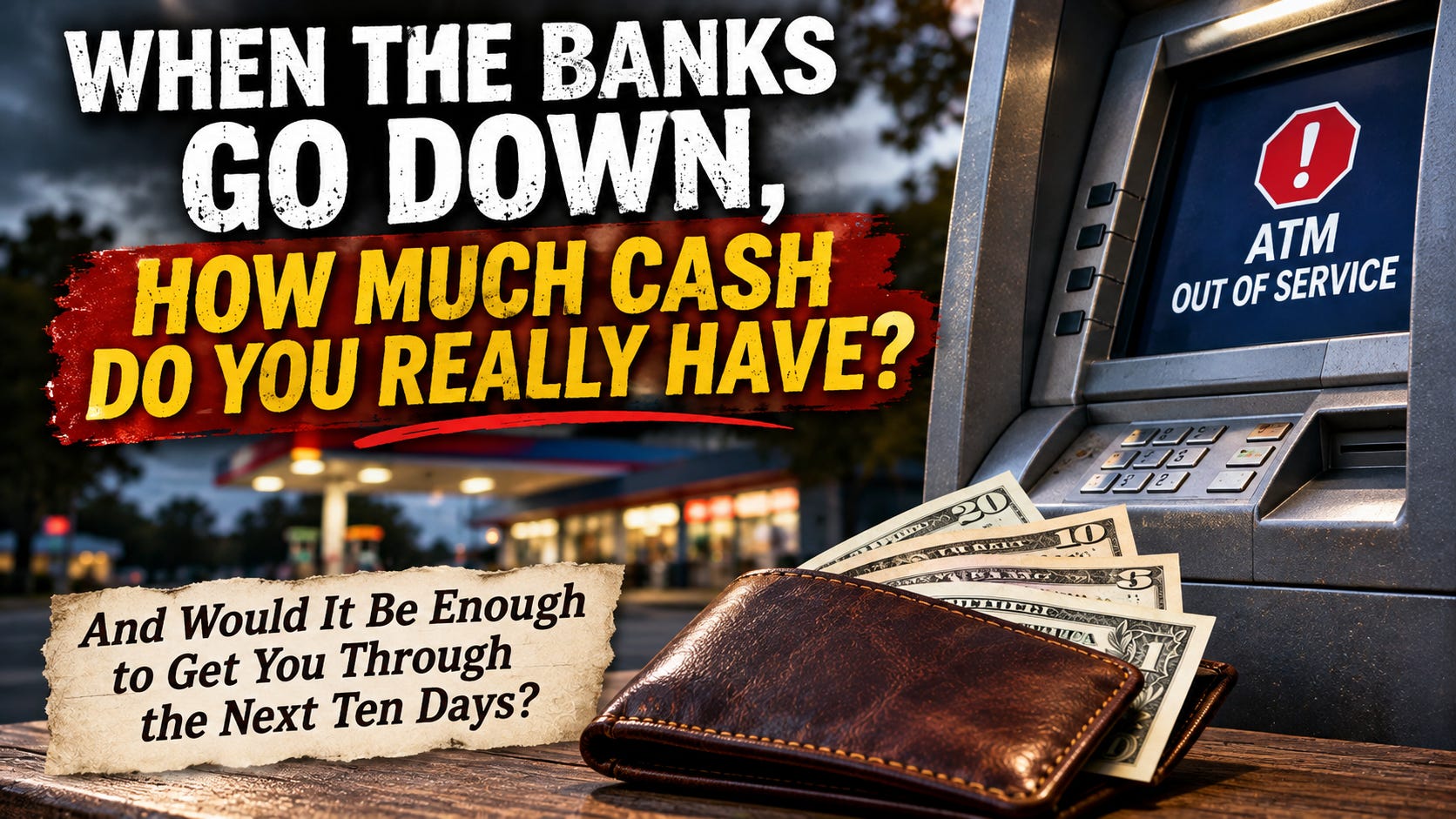
Suppose you wake up tomorrow morning, get dressed, and head off to work. You stop at the convenience store for a cup of coffee and some gasoline, only to discover your debit card doesn’t work.
You try your credit card. Same result.
Well, that’s aggravating.
You drive over to the ATM, thinking you’ll just withdraw a little cash and be on your way. Unfortunately, the ATM isn’t working either.
Now you’re getting a little irritated.
Then you discover the problem isn’t your bank account. There’s a widespread disruption affecting banking and electronic payment systems. Nobody seems to know exactly when everything will be working again.
It might be a few hours. It might be several days.
Now, let me ask you something.
How much actual cash do you have available right now?
I’m not talking about your checking account, savings account, or available credit.
I’m talking about the money in your wallet, your spouse’s purse, the kitchen drawer, or maybe that collection of loose change rattling around in your truck.
And here’s the more important question.
If you couldn’t access your money for the next five to ten days, would that cash be enough to get you through?
How Much Cash Do We Actually Have?
I was curious about this myself, so I did a little research.
According to the Federal Reserve’s 2026 Diary of Consumer Payment Choice, approximately 76% of consumers carried cash in their wallets, purses, or pockets during 2025.
The average amount among those carrying cash was just $69.
The same study found that approximately 45% kept additional cash somewhere else, generally for savings or emergencies. Among those who did, the average amount was $364.
Now, those are averages, and they don’t mean that each of us has $69 in our pocket and another $364 tucked away at home.
In fact, more than half of those surveyed didn’t report keeping that additional cash reserve at all.
Still, the numbers give us something to think about.
Sixty-nine dollars isn’t going to go very far these days, particularly if you have a family to take care of.
And if you happen to be one of those people who rarely carries cash, you might discover that your entire emergency reserve consists of $17 in your wallet, $4.38 in the truck’s console, and whatever you can shake out of the couch cushions.
Not exactly where you’d want to be.
Just How Long Would Your Cash Last?
Let’s forget about mortgages, car payments, insurance premiums, and the other bills we normally pay electronically.
For this discussion, we’re talking about the things we might actually need to purchase during a five-to-ten-day disruption.
Groceries. Gasoline. Prescriptions. Maybe a few household necessities.
Consider a family of four.
Let’s say they need $150 for groceries, $75 for gasoline, and another $50 for miscellaneous necessities over five days.
That’s $275.
Stretch the disruption to ten days, and those expenses could approach $550, assuming their needs remain about the same.
Those aren’t national averages. They’re simply examples of how quickly everyday expenses can add up. Your household might spend considerably more or less.
Now suppose that same family has $100 in cash available.
They’re going to have to make some decisions about what they purchase, what can wait, and what they can do without.
And that brings us to something I think deserves more attention.
We’ve Become Accustomed to Not Needing Cash
Think about how we conduct business today.
We swipe a card at the grocery store. Tap our phones at the convenience store. Pay for gasoline at the pump. Order something online.
Most of us don’t give it a second thought.
And why should we? It’s convenient, efficient, and usually works just fine.
Until it doesn’t.
A major power outage, communications failure, cyberattack, or other disruption could temporarily interfere with electronic payments and banking services.
It doesn’t necessarily mean our money is gone.
It simply means we might not be able to get to it when we need it.
And that’s a distinction worth remembering.
We could have several thousand dollars sitting in our checking accounts and still find ourselves standing at a cash register unable to purchase a gallon of milk.
Having cash doesn’t guarantee that every store will be open or able to conduct business. But when a merchant can still operate and accept currency, having cash gives us an option that a nonfunctioning debit card doesn’t.
There’s a Lesson Here From Continuity Planning
I’ve previously written about the military’s efforts to improve installation resilience and maintain essential operations when normal infrastructure becomes unavailable.
One of the things I find particularly interesting about those efforts is the underlying principle.
If something is important enough that we need it to function, we ought to consider what we’ll do if the system supporting it becomes unavailable.
Now, I’m certainly not suggesting that our households need military-style continuity plans.
But the basic idea makes just as much sense at home.
We keep flashlights around in case the electricity goes out.
Some of us keep extra drinking water in case the water supply is interrupted.
And when we can afford it, we might pick up a couple of extra cans of vegetables or soup at the grocery store. Over time, those extra purchases add up, and before long, we’ve built ourselves a little reserve in the pantry.
So why wouldn’t we approach emergency cash the same way?
A little at a time, building something useful that we can fall back on when we need it.
So How Much Cash Should We Keep?
Here’s where things get a little more complicated.
I’d love to tell you that we should all have $1,000 in emergency cash tucked away somewhere.
But I also recognize that a lot of us are having a difficult enough time keeping up with everyday expenses.
Groceries aren’t getting any cheaper. Neither are insurance, utilities, medical expenses, or much of anything else.
Heck, finding an extra $20 at the end of the week is an accomplishment.
So I’m not going to suggest that we all need to run down to the bank tomorrow and withdraw several hundred dollars.
Instead, I think we ought to look at this the same way we might build up a little extra food in the pantry.
Maybe it’s five dollars left over at the end of the week. Maybe it’s a ten-dollar bill we decide not to spend. Maybe it’s the loose change we empty out of our pockets at the end of the day.
None of that sounds particularly impressive by itself.
But five dollars a week adds up to $260 over a year. Ten dollars a week becomes $520.
And even if we can’t put anything aside for a few weeks, whatever we’ve already saved is still there.
The point isn’t to reach some particular dollar amount by next Friday.
It’s to start building a reserve that gives us a little more flexibility if we suddenly find ourselves unable to use our debit cards or withdraw money from the bank.
As for how much we eventually ought to have available, I think a reasonable goal is enough to cover our household’s essential cash purchases for several days, working toward five to ten days as circumstances permit.
That amount will be different for each of us.
Someone who drives fifty miles to work every day may need considerably more gasoline than someone who works from home.
A household with children may have expenses that a retired couple doesn’t.
And if we’ve already built up some extra food and other essentials, we may not need to spend as much cash during a disruption in the first place.
That’s another advantage of building our readiness a little at a time. The different pieces begin supporting one another.
A Few Practical Considerations
Personally, I think an emergency cash reserve should include smaller bills.
A collection of twenties, tens, fives, and a few ones may be considerably more useful than several hundred-dollar bills.
If the local convenience store is operating on a cash-only basis, we don’t want to discover that nobody can make change for our $100 bill.
I’d also suggest keeping emergency cash separate from the money we normally spend.
Otherwise, that carefully accumulated reserve might gradually disappear into coffee, gasoline, and the occasional fast-food lunch.
And, naturally, we should keep it somewhere reasonably secure and accessible to the people in our households who might need it.
Nothing particularly complicated about any of that.
One Last Thought
I don’t know whether we’ll experience a major electronic banking disruption next week, next year, or sometime further down the road.
And frankly, that’s not the point.
What interests me is how dependent we’ve become on systems that we rarely stop to think about.
We assume the lights will come on when we flip the switch.
We assume water will flow when we turn on the faucet.
And we assume that when we reach into our wallets and pull out a debit card, we’ll be able to purchase whatever we need.
Most of the time, those assumptions work out just fine.
But having a reasonable alternative available when they don’t is simply good planning.
So sometime today, when you have a few minutes, take a look around.
Check your wallet. Look in that kitchen drawer. Maybe even check the console in your vehicle.
Add up the cash you could actually put your hands on if the banks and electronic payment systems were unavailable.
Then ask yourself one simple question.
Could we get by on that amount for the next ten days?
If the answer is no, maybe that’s something we can begin working on.
A few dollars here. A little change there. Whatever we can reasonably manage.
We don’t have to accomplish everything overnight.
Because the last thing any of us wants is to be standing in front of an ATM that isn’t working, thinking, “Man, I meant to get some cash yesterday.”
Source: Federal Reserve Financial Services, 2026 Diary of Consumer Payment Choice (May 2026), reporting consumer payment data from 2025.
If banks go down, cash would be more worthless than. Fiat is regularly