


I recently started looking into reports that Cuba may have acquired hundreds of military drones from Russia and Iran.
That investigation led me somewhere I wasn’t expecting.
The more I looked at the capabilities of these drones, the less interested I became in Cuba alone.
I started thinking about the water surrounding the United States.
And I found myself asking a fairly simple question:
What if an adversary didn’t have to launch a drone from Cuba, Russia, Iran, China or anywhere else?
What if they could bring the drone much closer?
What if the launch point was somewhere offshore?
Not necessarily from a warship.
Possibly from some type of vessel operating at sea.
That question changes the geography considerably.
And unfortunately, the basic technology required to launch long-range attack drones from mobile platforms already exists.
These Aren’t Science-Fiction Weapons
When most people hear the words attack drone, they probably picture something like the large American Predator or Reaper drones we’ve seen in news footage for years.
That’s not what we’re talking about here.
Some modern attack drones are much simpler.
They are essentially small unmanned aircraft carrying an explosive warhead.
They are launched, fly toward a programmed destination and don’t come back.
They’re commonly called one-way attack drones.
The Iranian-designed Shahed family is probably the best-known example.
Russia has used enormous numbers of them against Ukraine.
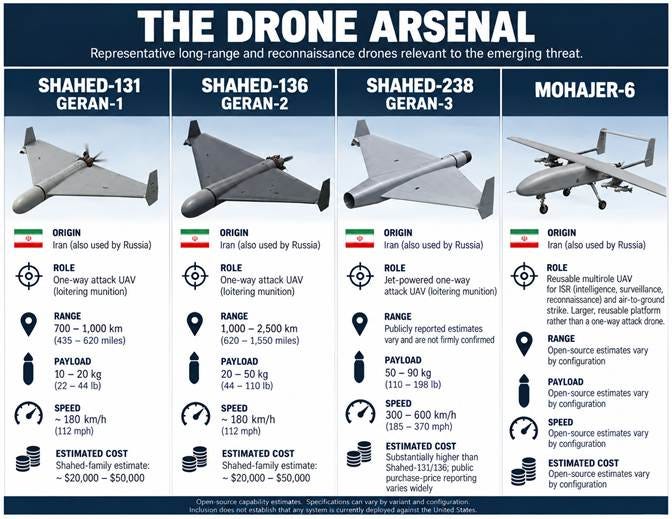
The U.S. Defense Intelligence Agency has publicly confirmed Russia’s use of Iranian Shahed-131 and Shahed-136 drones, which Russia calls the Geran-1 and Geran-2. DIA has also documented Russia’s use of the Iranian Mohajer-6, a larger reusable reconnaissance and strike drone. [Originally cited to DIA.]
These aren’t experimental weapons sitting on a drawing board.
They have been used in war.
A lot.
Consider the Shahed-136
The Shahed-136 is roughly 11 feet long with a wingspan around 8 to 10 feet.
It isn’t particularly fast.
About 110 miles per hour.
But speed isn’t what makes it interesting.
Range is.
Current CSIS estimates put its range somewhere between approximately 620 and 1,550 miles, depending on configuration and other factors.
Its warhead is comparatively small—roughly 44 to 110 pounds.
Estimated cost?
Roughly $20,000 to $50,000 apiece, although estimates vary and Russian production changes the calculation. [Originally cited to CSIS Missile Threat.]
Think about that for a moment.
We aren’t talking about a multimillion-dollar cruise missile.
We’re talking about a relatively inexpensive flying weapon with potentially more than a thousand miles of range.
Its smaller cousin, the Shahed-131, has an estimated range of roughly 435 to 620 miles and carries a smaller warhead.
Then there is the newer Shahed-238, also known in Russian service as the Geran-3.
That one is jet powered.
CSIS reports speeds ranging from roughly 185 to 370 miles per hour, depending on the version, with reported ranges varying considerably and payloads around 110 to 200 pounds. [Originally cited to CSIS Missile Threat.]
Suddenly the word drone begins to mean something quite different.
Now Move the Starting Point
This is where my original Cuba question changed.
Range is normally discussed from the country operating the weapon.
A drone located in Iran has to travel from Iran.
A drone located in Russia has to travel from Russia.
A drone located in Cuba has to travel from Cuba.
But what happens if the launch platform moves?
According to CSIS, Shahed-131 and Shahed-136 drones can be launched from truck-mounted systems and portable launchers. Reporting reviewed by CSIS also indicates that Shaheds can be launched from ships and other mobile platforms. [Originally cited to CSIS Missile Threat.]
And we don’t have to rely entirely upon foreign examples.
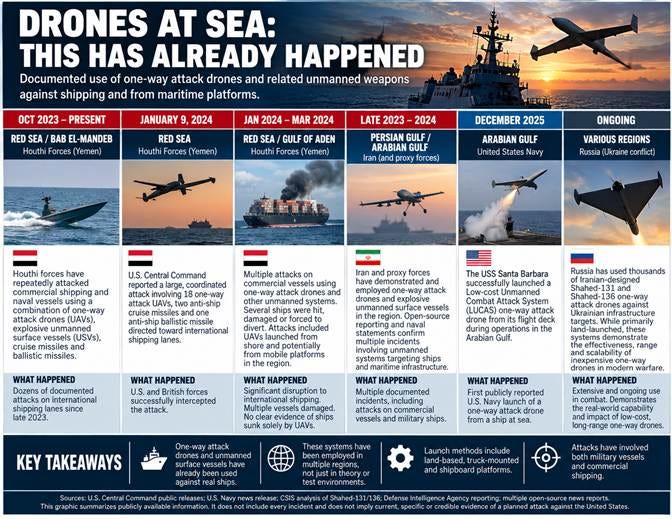
In December 2025, the United States Navy launched a one-way attack drone from a ship at sea.
The USS Santa Barbara launched the Low-cost Unmanned Combat Attack System, or LUCAS, from its flight deck while operating in the Arabian Gulf.
The Navy described it as its first successful launch of a one-way attack drone from a naval vessel. [Originally cited to USFF/Navy.]
That doesn’t mean an adversary could simply hide any military drone aboard any random freighter and successfully attack the United States.
There are significant technical, intelligence, logistical and operational problems involved.
But it does establish something important:
Launching this general class of weapon from a vessel at sea is technically possible.
And once you establish that, the map changes.
America Has A Lot Of Coastline
Look at a map of the United States.
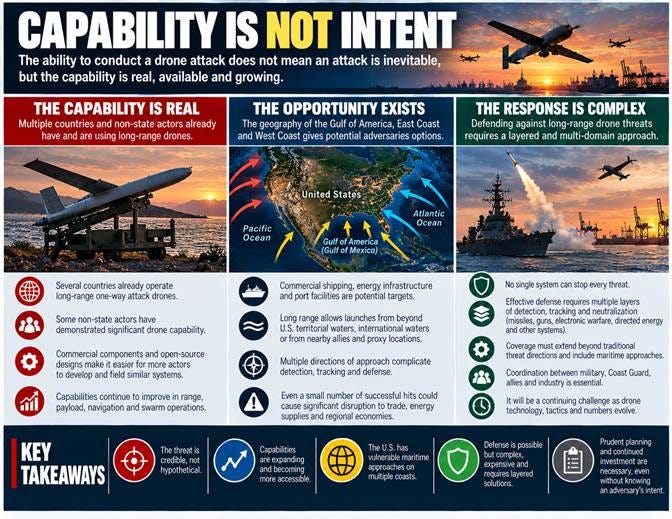
The Atlantic Ocean sits along the entire East Coast.
The Pacific sits along the West Coast.
The Gulf of America/Gulf of Mexico borders Texas, Louisiana, Mississippi, Alabama and Florida.
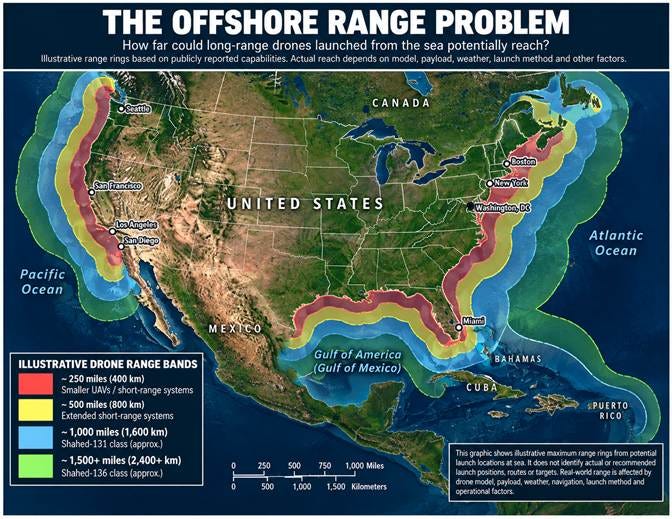
Now imagine moving the starting point of a 600-mile, 1,000-mile or 1,500-mile-range aircraft from another continent to somewhere offshore.
That’s the part that got my attention.
The ocean potentially becomes part of the launch geography.
A weapon doesn’t necessarily need intercontinental range if someone can move the launch platform closer.
And there is an enormous amount of maritime traffic around the United States every day.
Cargo ships.
Tankers.
Container ships.
Fishing vessels.
Work boats.
Pleasure craft.
Military vessels.
Thousands of legitimate vessels moving through an enormous maritime environment.
I’m not suggesting enemy drones are presently sitting aboard commercial ships waiting to attack America.
I have found no credible public evidence establishing that.
I’m asking a different question.
Could the technology make an offshore drone threat possible?
The answer appears to be yes.
We’ve Already Seen What Inexpensive Drones Can Do At Sea
The maritime part isn’t theoretical either.
Beginning in late 2023, Houthi forces in Yemen repeatedly attacked commercial shipping and naval vessels in and around the Red Sea.
Those attacks included one-way attack drones, cruise missiles and ballistic missiles.
On January 9, 2024, for example, U.S. Central Command reported a coordinated attack involving 18 one-way attack UAVs, two anti-ship cruise missiles and one anti-ship ballistic missile directed toward international shipping lanes.
U.S. and British forces intercepted the attack. [Originally cited to CENTCOM.]
CENTCOM subsequently reported dozens of attacks against vessels operating in the region. [Originally cited to CENTCOM.]
The lesson isn’t that the Red Sea and the United States are identical.
They aren’t.
The lesson is simpler.
Relatively inexpensive unmanned aircraft have already become part of modern maritime warfare.
The Economics May Be As Important As The Technology
Here’s another part of this story that deserves attention.
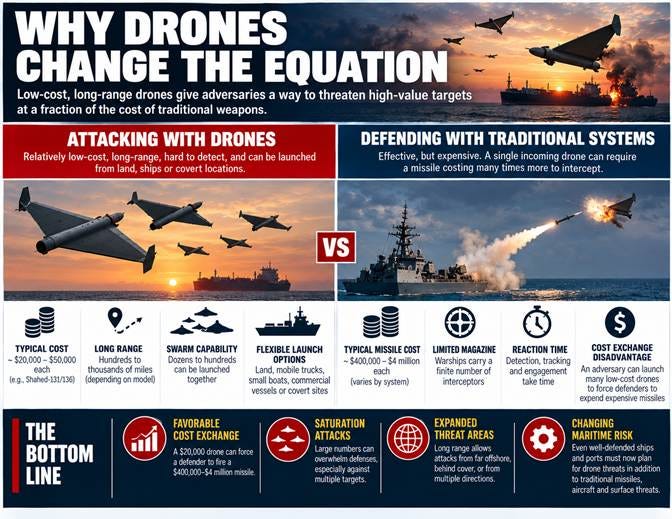
These drones can be cheap compared with the weapons traditionally used to shoot aircraft and missiles down.
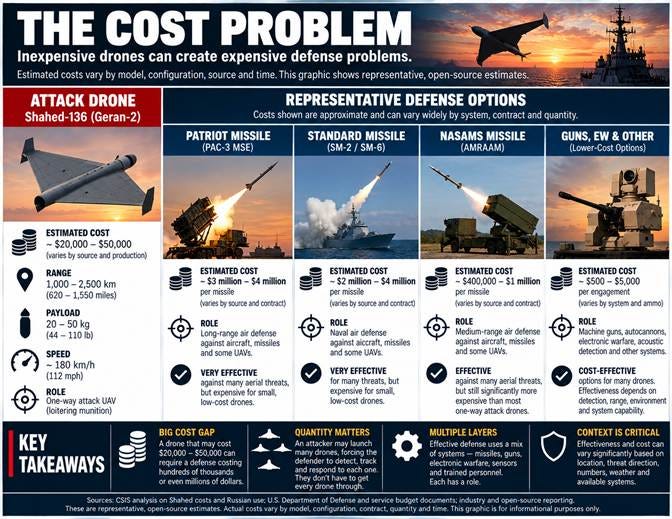
CSIS has used an estimated cost of about $35,000 for a Shahed-type drone in analyzing Russia’s campaign against Ukraine.
Meanwhile, some sophisticated surface-to-air interceptors cost more than $1 million, and certain Patriot interceptors cost several million dollars. [Originally cited to CSIS.]
That doesn’t mean every drone requires a multimillion-dollar missile.
Ukraine has learned to use machine guns, electronic warfare, acoustic detection and other lower-cost defensive systems against them.
But it illustrates the problem.
Imagine spending $1 million to destroy something that cost the attacker $35,000.
Now imagine ten drones.
Or fifty.
The attacker doesn’t necessarily have to get every drone through.
The attacker may simply force the defender to detect, track and respond to every one of them.
That is exactly one of the lessons coming out of Ukraine.
Russia has increasingly used large numbers of relatively inexpensive drones to pressure and exhaust Ukrainian air defenses. By early 2026, CSIS assessed that Russia was averaging more than 5,000 drones per month in its campaign. [Originally cited to CSIS.]
Quantity becomes a weapon of its own.
So Why Not Just Shoot Them Down?
Some certainly can be.
Ukraine has destroyed huge numbers of them.
But drones present an awkward detection problem.
They’re smaller than conventional aircraft.
Some fly relatively slowly.
They can approach at low altitude.
And the defender has to distinguish an actual threat from everything else moving through the air.
The U.S. government clearly takes that problem seriously.
The Coast Guard says unmanned aircraft present increasing maritime-security challenges because of their potential payloads and difficulty of detection. It is actively researching rapidly deployable counter-drone systems for maritime operations. [Originally cited to USCG.]
DHS has likewise been expanding counter-UAS capabilities for federal facilities, border security, law-enforcement operations and major events. [Originally cited to DHS.]
That doesn’t mean the United States is defenseless.
Far from it.
It means the government recognizes the same technological change we’re discussing here.
The drone problem is real enough that we’re actively building defenses against it.
What Could An Adversary Actually Accomplish?
This is where we have to separate capability from imagination.
A 50-pound warhead isn’t going to flatten a city.
Even a larger drone isn’t remotely comparable to a strategic bomber or ballistic missile.
But that doesn’t make it harmless.
Modern societies depend upon enormous networks of infrastructure.
Electricity.
Communications.
Transportation.
Ports.
Fuel distribution.
Industrial facilities.
Military installations.
The concern isn’t necessarily one drone carrying an enormous bomb.
It is that relatively inexpensive unmanned weapons can give an adversary another way to create disruption without using traditional aircraft or missiles.
Exactly how effective such an attack would be depends upon defenses, intelligence, numbers, reliability, navigation, weather and many other factors.
Some scenarios that look frightening on a map may prove very difficult in the real world.
Others may prove easier than we would like.
That’s why this deserves study rather than exaggeration.
Russia, Iran And China Aren’t The Only Consideration
Another mistake would be concentrating entirely on one country or one particular drone.
Technology spreads.
The Shahed family is important because it has been used extensively and its capabilities are relatively well documented.
But the broader issue is the combination of three things:
Range.
Cost.
Mobility.
Once inexpensive unmanned weapons acquire significant range and can be launched from mobile platforms, geography begins working differently.
An adversary doesn’t necessarily need an airbase nearby.
It doesn’t necessarily need a large bomber.
And it doesn’t necessarily need a multimillion-dollar cruise missile.
That is the technological change worth watching.
Could This Actually Happen To The United States?
Technically?
Yes.
I think the available evidence supports saying that.
Do we have evidence that Russia, China, Iran, Cuba or another foreign government currently has a ship offshore preparing to launch drones at the United States?
No.
I have found no credible public evidence establishing anything like that.
Those are two completely different statements, and we shouldn’t confuse them.
But national security isn’t only about discovering an attack after somebody decides to conduct one.
It’s also about understanding what has become possible before somebody decides to try it.
Twenty years ago, the idea of relatively inexpensive unmanned aircraft flying hundreds or even thousands of miles carrying explosive warheads sounded like something from a military research laboratory.
Today they’re being manufactured by the thousands and used routinely in warfare.
They’ve attacked infrastructure.
They’ve attacked military positions.
They’ve been used around shipping lanes.
And we’ve now demonstrated that this general category of weapon can operate from a ship at sea.
That deserves our attention.
The Question We Should Be Asking
I started this investigation wondering what kinds of drones Cuba might possess.
I ended it thinking about something much larger.
Maybe the most important question isn’t:
How far can a drone fly from Cuba?
Maybe it’s:
How far can a drone fly from wherever somebody can bring the launcher?
That’s a very different question.
And when you look at America’s geography—the Atlantic, Pacific and Gulf surrounding thousands of miles of coastline—it becomes one worth understanding.
Not fearing.
Not exaggerating.
Understanding.
Because one thing the wars in Ukraine and the Middle East have made increasingly clear is this:
The age of inexpensive long-range drone warfare isn’t coming.
It’s already here.
— Bobby Bama
This article is an open-source exploration of emerging drone capabilities and maritime security. It does not allege that any country or organization is presently preparing an offshore drone attack against the United States. Performance figures and costs are estimates drawn from publicly available sources and can vary substantially by model, configuration and operating conditions.
Spot on brother. That is a lot to think about and a heavy at that. This vountry is already at a breaking point with all the division inthis country and actually something like this happens it will be total chaos and panic in the streets