


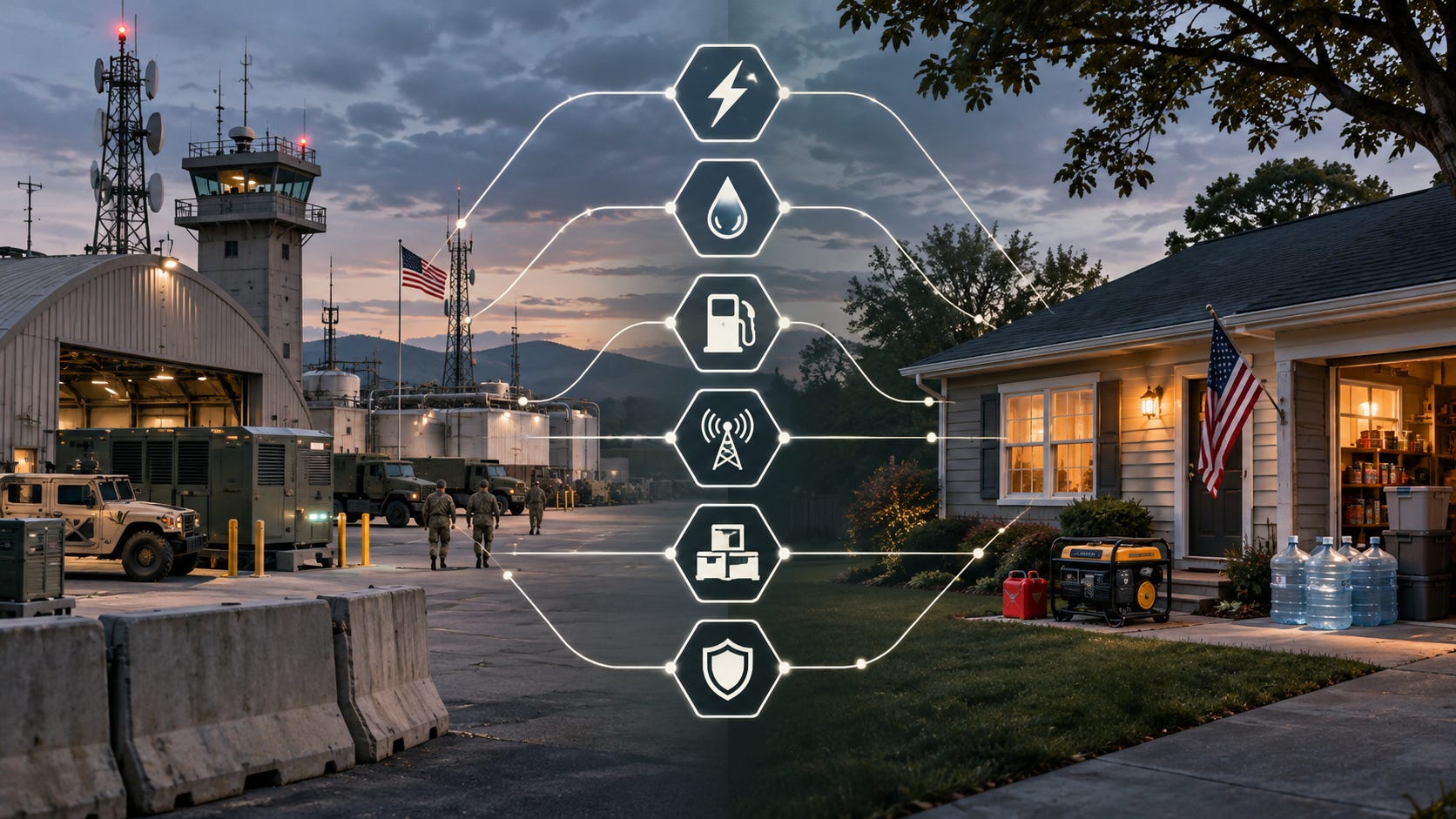
I’ve been following the military’s FORTRESS America initiative, and I have to say, there’s quite a bit about it that I find interesting. Especially, when I start comparing what the military is trying to accomplish with what some of us are trying to accomplish in our own homes.
For those unfamiliar with it, FORTRESS America is a Department of Defense initiative aimed at making military installations more resilient and less dependent on outside infrastructure and supply systems. One of the objectives being pursued is the ability to sustain essential operations for up to 90 days without outside support.
Three months of maintaining essential capabilities, even when the systems an installation normally depends upon aren’t available.
Now, there’s obviously a considerable difference between operating a military installation and taking care of a household. The missions are different, the resources are different, and so are the responsibilities. But the more I read about the initiative, the more I realized that the military is approaching some of the same problems that concern me when I think about my family’s readiness.
And the military’s approach makes a lot of sense to me.
Rather than concentrating solely on getting through an emergency, the military is looking at how to continue operating while the emergency is taking place. That means identifying the capabilities it needs, understanding what those capabilities depend upon, and developing ways to sustain them when normal support isn’t available.
That’s pretty close to what I’ve always wanted to accomplish with my own household.
FORTRESS America addresses several interconnected areas, including energy independence, supply-chain resilience, strategic reserves, infrastructure protection, cybersecurity, and the ability to maintain critical communications-related capabilities.
Consider the military’s interest in energy independence. If the civilian power grid fails, military installations still have missions to carry out. That means having alternative sources of electricity and the ability to keep them operating for an extended period.
Well, I don’t particularly want my household completely dependent on the electrical grid either. If we lose power, I’d like to maintain the things that matter most to us. But having a generator or some other backup power source is only part of the answer. I also need to know how long I can operate it and whether I have the fuel, equipment, and other resources necessary to keep it going.
The same thinking applies to supply chains and strategic reserves. The military needs fuel, equipment, replacement parts, and supplies to continue operating. It can’t count on everything being readily available during a major disruption, so it has to consider what needs to be maintained in reserve.
Our needs are considerably smaller, but we depend on supply chains just as surely as the military does. Groceries, medications, fuel, and countless other necessities arrive through systems that usually work so well we barely notice them.
Until they don’t.
Communications and infrastructure present similar concerns. The military needs dependable communications, secure systems, and functioning infrastructure to carry out its mission. At home, we may be concerned about maintaining contact with family members, keeping water available, protecting our property, or simply preserving the services that make everyday life possible.
And here’s something else I find interesting about the military’s approach. These aren’t entirely separate problems. They’re connected.
Electricity may be necessary to operate water pumps, refrigeration, communications equipment, and security systems. Fuel may be needed for backup power, transportation, or heating. A failure in one area can create problems in several others, sometimes before we even realize what’s happening.
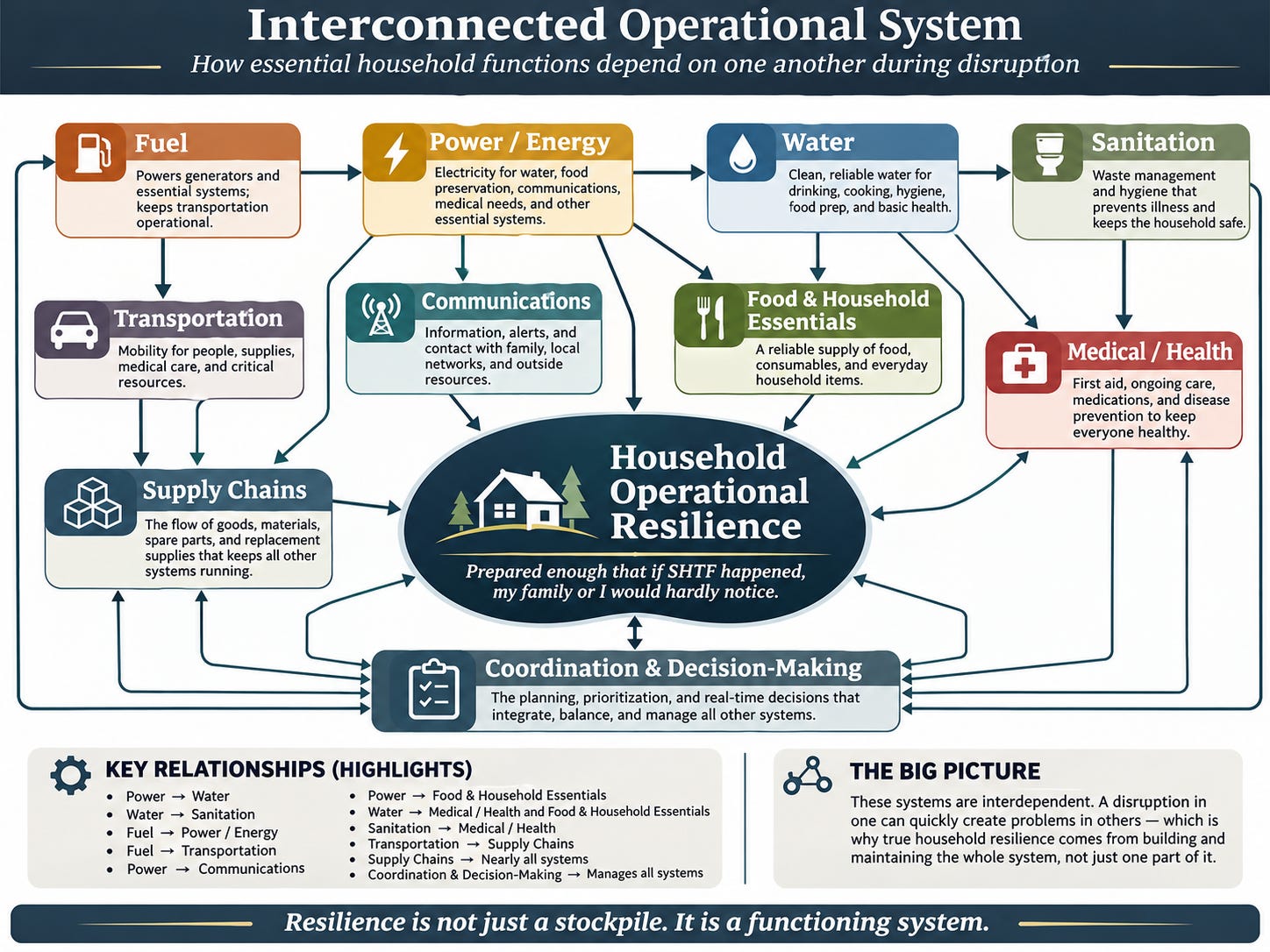
That’s why I think the military’s emphasis on interconnected capabilities is worth considering. It isn’t enough to have individual resources available. Those resources also need to work together, and we need to be able to sustain them for whatever period we’re planning to cover.
Which brings me back to that 90-day objective.
We’ve all heard the familiar recommendations about keeping at least 72 hours of emergency supplies. Three days of food, water, and other necessities. There’s nothing wrong with that in theory.
But I’ve wondered for a long time whether people sometimes hear that recommendation, particularly when it comes from an official source, and assume that once they’ve met it, they’re reasonably well prepared.
Maybe they are, depending on what happens. But what if the disruption lasts longer than three days? What about a week? Two weeks? Or a month?
That’s where I think the military’s approach provides some useful perspective.
If the military considers maintaining essential capabilities for an extended period important enough to pursue a 90-day sustainment objective, why wouldn’t we at least consider what a longer period of independence might mean for our own households?
I’m certainly not suggesting that everyone needs to prepare for 90 days. Some people have the financial resources and storage space to accomplish considerably more than others. Some may have difficulty maintaining even a week’s worth of supplies. Everyone has to work within their own circumstances and decide what’s reasonable for them.
But regardless of where we start, I don’t see any reason to automatically treat 72 hours as the finish line.
Wouldn’t it make sense to consider what additional security we might gain by extending our capabilities beyond that? Not necessarily by buying more equipment or filling every available closet with supplies, but by improving our ability to maintain the things we depend upon.
I’ve mentioned my own personal readiness objective before, and it really hasn’t changed:
“If SHTF happened, I want to be prepared enough that my family or I would hardly notice.”
Now, I realize that’s an ambitious objective. I don’t expect to eliminate every inconvenience or somehow make our household immune to whatever happens around us. But I want to come as close to that objective as my circumstances and resources will reasonably allow.
If the electricity goes out, I want us to have options. If the water stops running, I’d prefer to already have a workable alternative. And if normal services aren’t restored as quickly as expected, I want us to be able to continue taking care of ourselves without having to make major adjustments every time something else becomes unavailable.
That’s what readiness means to me. Not simply having enough supplies to get through a few difficult days but having the capability to maintain as much of our normal lives as possible.
And that’s also why FORTRESS America caught my attention in the first place.
The military is examining what it needs to keep operating, what could interrupt those operations, and how long it can maintain essential capabilities without outside support. I don’t see any reason why civilians couldn’t benefit from considering those same questions, adjusted to their own circumstances.
Of course, whether the military ultimately achieves everything envisioned under FORTRESS America remains to be seen. It’s an ambitious undertaking, and I suspect there will be plenty of challenges along the way.
But we don’t have to wait for the military to complete the initiative to appreciate the thinking behind it.
The military has its mission, and we have our own responsibilities. We don’t need the same equipment, the same resources, or even the same sustainment objectives. But we do share an interest in keeping essential capabilities functioning when the systems around us aren’t.
And if the military is planning for how long it can continue operating without outside support, shouldn’t we at least be asking ourselves the same question?