


A friend asked me recently if I had ever heard of the “Double Hater Party.”
I hadn’t.
So, I looked it up.
Turns out, as best I can tell, there is no actual Double Hater Party.
There are, however, “double haters.”
That’s the considerably more entertaining name being used for Americans who look at our two major political parties and find themselves less than thrilled with either one.
Well.
That got my attention.
Then one thing led to another.
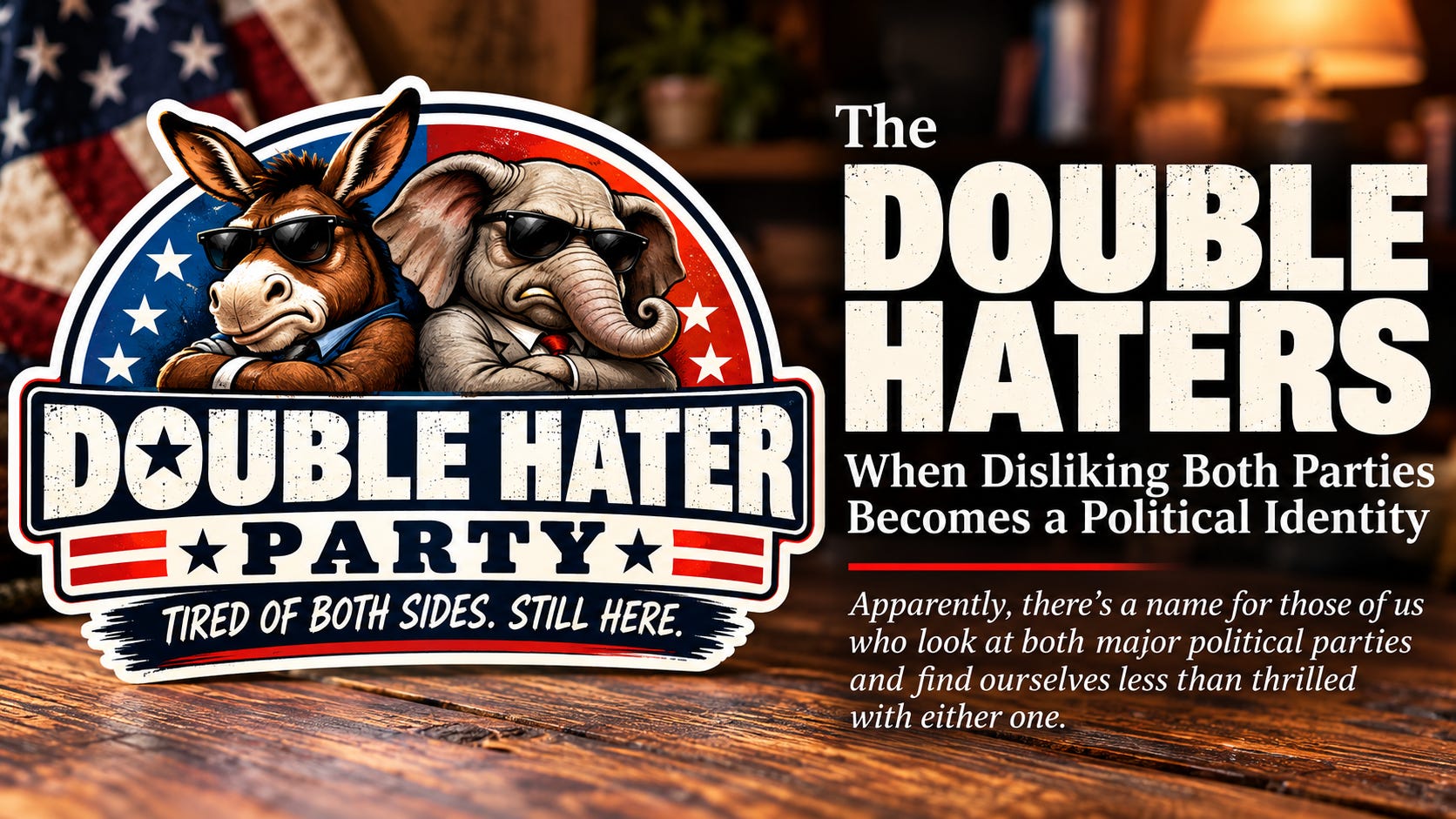
Somebody joked that the Double Hater Party needed a logo.
So naturally, we made one.
An irritated-looking donkey and an equally irritated-looking elephant, both wearing sunglasses, standing shoulder to shoulder beneath the words:
DOUBLE HATER PARTY
And underneath:
TIRED OF BOTH SIDES. STILL HERE.
I laughed.
Then I looked at it again.
Then I ordered stickers.
I’m not saying I’m ready to become chairman of the Double Hater Party.
I’m just saying I already have the merchandise.
The party may be a joke.
The people behind the joke aren’t.
Apparently, There Are Quite a Few of Us
It turns out that dissatisfaction with both political parties isn’t particularly unusual.
Recent Pew Research Center polling found that roughly one-quarter of American adults view both parties unfavorably. Another Pew survey found about one-quarter saying neither political party represents the interests of people like them even somewhat well.
Different questions, but they point toward something worth noticing.
There are a lot of Americans looking at the political choices in front of them and saying:
Is this really the best we’ve got?
That doesn’t necessarily mean they’re moderates.
It doesn’t mean they’re independents.
It doesn’t mean they dislike both parties equally.
And it certainly doesn’t mean they’d agree with one another if you put them all in the same room.
Some lean right.
Some lean left.
Some probably haven’t moved much politically at all. They’ve simply become increasingly dissatisfied with the party they traditionally supported.
Whatever the reason, political homelessness appears to be getting a little crowded.
Which raises an interesting question.
If so many people are dissatisfied with both parties, have they simply stopped caring?
Apparently not.
Disillusioned Doesn’t Have to Mean Disengaged
This may be the most interesting part of the whole thing.
Research on these so-called Double Haters suggests many remain politically engaged. They follow what’s happening. They vote. Politics matters to them.
That makes sense to me.
Some of us aren’t frustrated with politics because we’ve stopped caring.
We’re frustrated because we haven’t.
We still believe in “We the People.”
We still believe the people we elect work for us—not the other way around.
And maybe that’s exactly why it bothers us when neither political party feels particularly interested in representing us.
Political parties don’t own the house.
We do.
They’re supposed to be competing for the opportunity to help us run it.
Political disillusionment doesn’t necessarily mean somebody has given up on the country, the Constitution, elections or representative government.
Sometimes it may mean exactly the opposite.
Maybe you’re irritated because you still expect those things to work.
Maybe you’re frustrated because you still expect elected officials to represent the people who sent them there.
Maybe you’re paying attention because you haven’t surrendered your seat at the table.
Disillusioned doesn’t have to mean disengaged.
Sometimes disillusionment may simply mean you’re still very much engaged.
You just don’t particularly like what you’re seeing.
Then There’s That “Uniparty” Thing
If you’ve spent much time around politically dissatisfied people, you’ve probably heard the term “uniparty.”
People mean different things by it.
Some use it almost literally—the belief that Republicans and Democrats are essentially two wings of the same political establishment.
Others mean something less literal. They recognize differences between the parties but believe that, once you get far enough inside Washington, those differences sometimes seem considerably smaller than the campaign speeches would have you believe.
I’m not going to settle that argument here.
I’m not sure anybody could.
Maybe what some people mean by “uniparty” is something simpler:
Washington keeps changing hands, everybody keeps promising to fix it, and somehow an awful lot of the things people are angry about are still waiting to be fixed.
Whether that’s reality, perception, or some combination of the two is a discussion for another day.
For our purposes, the important thing is that the perception exists.
And apparently quite a few people understand the feeling behind it.
Welcome to the Party. Please Don’t Expect Us to Agree.
There’s another problem with turning Double Haters into an actual political tribe.
We aren’t one.
Some are conservative.
Some are liberal.
Some are libertarian.
Some are populist.
Some are genuinely moderate.
Some probably vote Republican most of the time but don’t particularly like the Republican Party.
Others probably do the same thing with Democrats.
And some may bounce back and forth depending on the candidate, the issue or what happened since the last election.
If we ever actually hold the first Double Hater Party convention, I suspect we’ll make it through the Pledge of Allegiance before somebody demands a rules change.
By lunch, we’ll probably have three competing factions and somebody threatening to start the Real Double Hater Party across the street.
Which, come to think of it, would make us a completely legitimate American political movement.
The common denominator isn’t ideology.
It’s dissatisfaction with the available political homes.
And apparently there are enough people feeling that way that pollsters and political reporters have decided they’re worth counting.
Fine. Let’s Start Another Party.
Here’s where Americans become wonderfully complicated.
Polling has repeatedly found strong support for the idea that the country needs another major political party.
Gallup recently found that roughly six in ten Americans said Republicans and Democrats were doing such a poor job that a third major party was needed.
Sounds promising.
So let’s start one.
Will everybody vote for it?
Well...
Whoa.
Let’s not get carried away.
When Gallup asked about actually voting for a third-party candidate, enthusiasm dropped dramatically.
And that’s understandable.
People worry about wasting their vote.
They worry their preferred alternative can’t win.
And perhaps most importantly, they worry that voting for Candidate C might help elect whichever of Candidates A or B they dislike the most.
So apparently Americans overwhelmingly want another choice...
provided choosing it doesn’t require us to actually choose it.
Fair enough.
Nobody said democracy was going to be simple.
It does, however, create an interesting trap.
People can become dissatisfied with both parties while continuing to vote for one of them because they consider the alternative worse.
Then both parties can look at the election results and conclude:
See? They still love us.
Maybe.
Or maybe some of those votes mean:
Congratulations. I disliked you slightly less.
There’s probably room on a bumper sticker for that one too.
About That Word “Hater”
For the record, the polling doesn’t actually ask whether people hate Republicans and Democrats.
Researchers generally measure things like favorable and unfavorable opinions.
“Double hater” is political shorthand.
Which is probably fortunate.
“Americans Expressing Simultaneous Unfavorable Attitudes Toward Both Major Political Parties” wasn’t going to fit on the sticker.
So Double Haters it is.
And maybe the exaggerated name is part of why the joke works.
People hear it and laugh.
Then sometimes they stop for a second.
Because underneath the joke is a feeling they recognize.
Maybe not hatred.
Maybe frustration.
Disappointment.
Distrust.
Political homelessness.
Or simply the nagging feeling that neither of the choices being offered quite belongs to you.
Tired of Both Sides. Still Here.
When we made the Double Hater Party logo, I thought the clever part was the name.
Now I’m not sure it is.
The more I look at it, the words underneath may say considerably more:
TIRED OF BOTH SIDES. STILL HERE.
The first half is frustration.
The second half is something else.
Still here.
Still paying attention.
Still voting.
Still asking questions.
Still arguing.
Still expecting something from the people we elect.
Still believing that We the People means something.
Still unwilling to surrender our seat at the table simply because neither political party particularly impresses us.
That’s not apathy.
It may simply be political disillusionment without political surrender.
Disillusioned doesn’t have to mean disengaged.
Maybe that’s what the Double Hater idea accidentally stumbled onto.
I don’t know whether America needs a Double Hater Party.
I’m reasonably certain America doesn’t need another political organization announcing that it alone has finally figured everything out.
But perhaps there’s value in recognizing that an awful lot of Americans don’t fit comfortably into the political boxes provided for them—and haven’t stopped caring simply because they don’t.
They haven’t left.
They’re still here.
And maybe that’s not such a bad political platform after all.
Although, to be clear, we still don’t have an actual party.
We do have stickers.
You’ve got to start somewhere.
Sources & Further Reading
Pew Research Center — Americans continue to view both the Republican and Democratic parties negatively
May 1, 2026. Pew found that 26% of U.S. adults held unfavorable views of both major parties, up from 21% in 2020.
Pew Research Center — How well the Republican and Democratic parties represent Americans’ interests
October 30, 2025. Pew found that 25% of Americans said neither major party represents the interests of people like them even somewhat well.
Gallup — Americans See Need for Third Party, but Offer Soft Support
October 20, 2025. Gallup found that 62% of Americans said a third major party was needed, while only 15% said they were very likely to vote for a third-party candidate.