


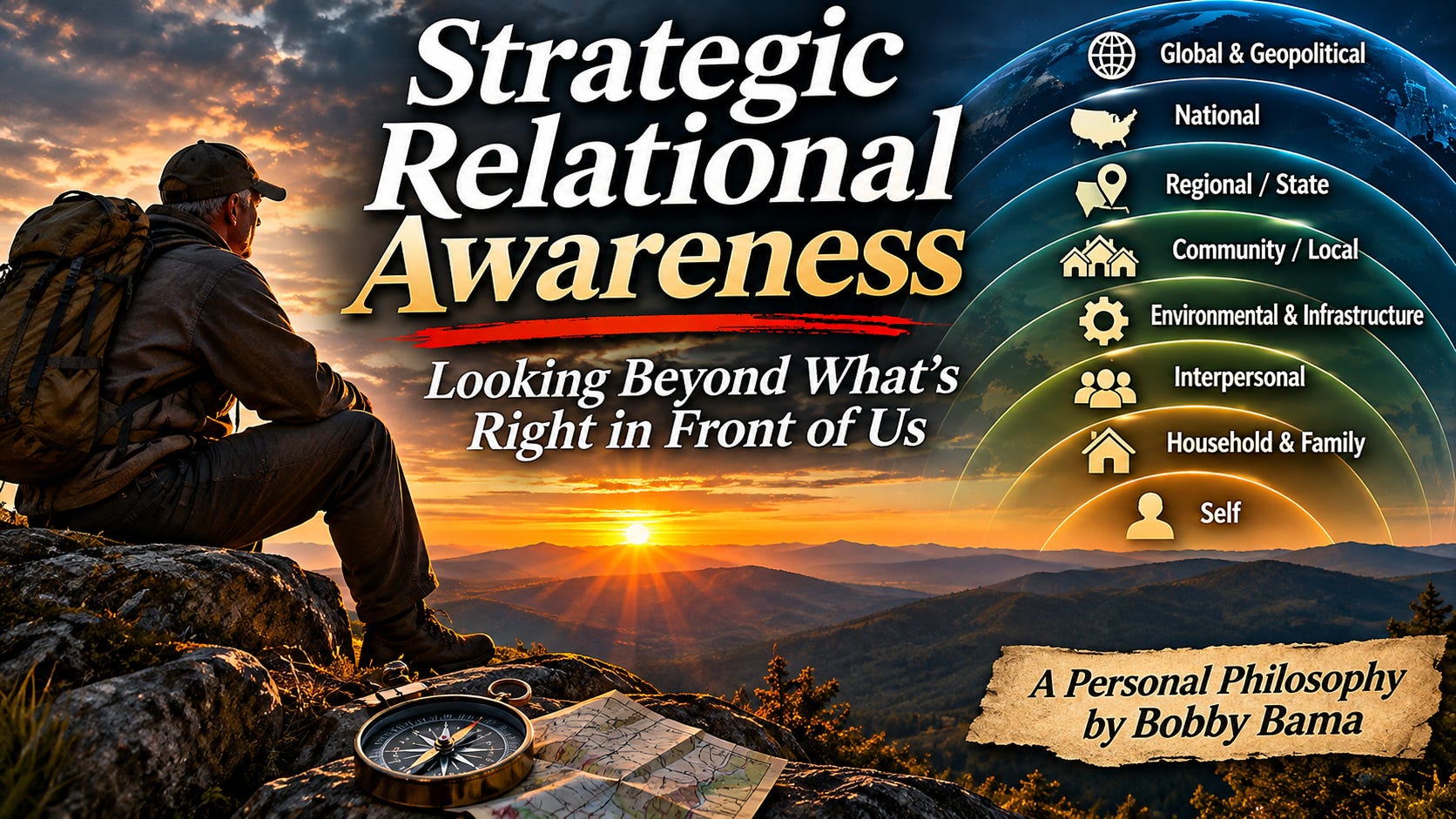
Most of us have heard the term situational awareness. We generally understand it to mean paying attention to what’s happening around us, recognizing potential problems, and considering what might happen next.
That’s important. But I’ve come to believe awareness needs to reach a good deal further than our immediate surroundings.
What about understanding ourselves? The people we deal with? The relationships we build? The decisions we make today that may affect us years from now?
And what about something happening hundreds or thousands of miles away that could eventually affect our families, jobs, finances, or communities?
Those things may seem unrelated at first. Sometimes they are. But sometimes there’s a connection worth understanding.
For more than four decades, I’ve practiced a way of thinking that helps me recognize and evaluate those connections. I was doing it long before I had a name for it.
I’ve decided to call it Strategic Relational Awareness.
I’m putting it into words because I believe there’s something useful here that others may want to consider.
Why those words?
I chose the name deliberately.
Relational refers to the connections between people, circumstances, decisions, resources, and events. Those connections aren’t always obvious, and they don’t all deserve the same attention. The challenge is recognizing which ones actually matter.
Strategic means looking beyond what’s happening right now. It’s considering what something could mean later, what options we have, and whether there’s something useful we can do today to improve our position tomorrow.
Put the two together, and you have a way of thinking about how things are connected, why those connections matter, and what you might do with that understanding.
It’s not simply about recognizing trouble. It’s also about recognizing opportunities, strengthening relationships, developing capabilities, and making better decisions.
Start with yourself, then widen the view
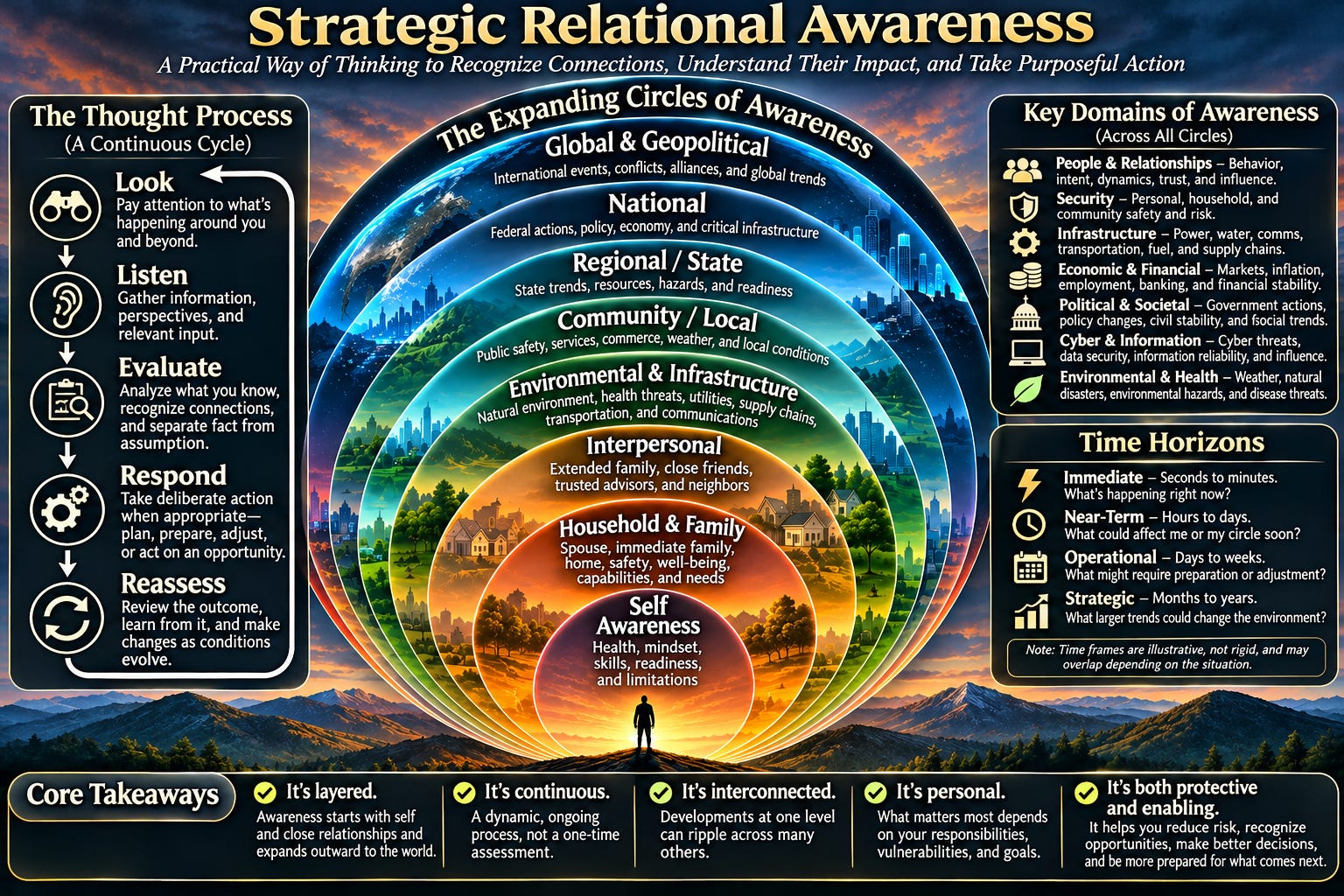
One way I explain this is to picture a series of expanding circles.
You’re at the center.
Moving outward are your immediate family, extended family and close friends, other relationships, neighbors and community, institutions and essential services, and finally national and global conditions.
The circles aren’t walls. And they certainly don’t mean something closer to you is necessarily more important than something farther away.
They’re simply a reminder of how widely the things affecting our lives can reach.
Consider a major employer in a nearby town announcing layoffs. You may not work there or know anyone who does. But perhaps several local businesses depend heavily on that employer’s workforce. Maybe your own business depends on one of those businesses.
Now there’s a potential connection.
Does that mean the layoffs will hurt you financially? Not necessarily.
But it gives you a reason to ask a few questions rather than assume the event has nothing to do with you.
That’s what I’m getting at. Recognize a possible connection without automatically treating it as an established fact.
Awareness ought to lead somewhere
But here’s something I consider important.
We can spend a lifetime watching the news, gathering information, and talking about everything that might go wrong. But if none of that understanding improves our decisions or our ability to act, what have we accomplished?
My thought process is straightforward:
Look. Listen. Evaluate. Respond. Reassess.
Pay attention to what’s happening. Listen carefully. Evaluate what you know and what you’re merely assuming. Decide whether a response is warranted. Then reassess as circumstances change or new information becomes available.
Sometimes responding means taking immediate action. Sometimes it means asking another question, making a plan, learning a skill, or strengthening a relationship.
And sometimes the right response is to do nothing beyond keeping an eye on the situation.
The important thing is that you’ve considered your options and made a deliberate decision.
That word “respond” matters. Without it, awareness risks becoming nothing more than an exercise in thinking.
Think about an ordinary power outage
Suppose the electricity goes out at your house.
Most of us can manage a couple of hours without much difficulty. But what if it lasts several days?
What stops working? Who depends on you? Can you communicate? Can you travel? Does someone outside your household need assistance? What happens if the outage affects an entire region rather than just your neighborhood?
Those questions lead to others.
Maybe you discover that your family has plenty of food but no practical way to prepare it without electricity. Or perhaps you have backup power but haven’t considered how a prolonged outage might affect your ability to work.
You begin to see how one disruption can create problems somewhere else.
Now you’re in a position to decide what preparation makes sense for your circumstances.
Notice that we didn’t start with a shopping list. We started by understanding the situation.
The philosophy guides the thinking. The thinking informs the preparation. The preparation develops readiness.
And when the lights come back on, there’s still something to learn. Did your arrangements work? Were your assumptions correct? What should you change before the next outage?
That’s reassessment.
People are part of the picture, too
This isn’t limited to emergencies, infrastructure, or financial decisions.
Think about the people you know.
Over time, you learn how someone normally behaves. You become familiar with their habits, interests, and the way they interact with others.
Then something changes.
Maybe a longtime neighbor suddenly becomes unusually interested in your family’s schedule and activities.
Does that mean he’s up to something? Of course not.
Maybe he’s lonely. Maybe he needs help. Maybe he’s simply trying to become better acquainted.
But you’ve noticed a change, and you have a reason to pay attention.
You can remain friendly while maintaining reasonable boundaries. You can listen, observe, and consider different explanations without rushing to judgment.
The same thinking applies when considering a business partner, joining an organization, or deciding how much responsibility to place in someone’s hands.
And remember, the outcome doesn’t always have to be defensive.
That neighbor might become a good friend. A new acquaintance might introduce you to an opportunity you otherwise would have missed.
If all we’re looking for is trouble, we’re likely to overlook some of the best things life has to offer.
There’s a difference between instinct and evidence
After many years of investigative work, I’ve learned to pay attention when something doesn’t seem quite right.
Call it instinct, a red flag, or that old spidey sense.
But I’ve also learned that a feeling isn’t proof.
It may be a good reason to look more closely, ask questions, or consider another explanation. It isn’t a substitute for evidence.
Our experience can help us recognize patterns, but it can also lead us toward assumptions that turn out to be wrong.
That’s why being willing to reconsider our own conclusions is so important.
We ought to challenge what we think we know just as readily as we challenge what someone else tells us.
A way of life, not another checklist
I don’t want anyone to misunderstand what I’m describing.
Strategic Relational Awareness isn’t about walking around suspicious of everyone or constantly anticipating disaster.
And it isn’t a procedure you have to consciously perform every time you make a decision.
Much of it becomes second nature.
It’s a practical mindset supported by a way of organizing your thinking. It encourages you to look beyond the obvious, recognize connections, question assumptions, consider consequences, and act when doing so makes sense.
It applies to family, work, finances, relationships, personal safety, preparedness, and everyday decisions.
It can help you recognize a vulnerability before it becomes a problem. It can also help you recognize an opportunity before it passes.
Why I’m sharing it
I’m not claiming to have invented situational awareness, strategic thinking, or the principles of sound judgment. There are established ideas in all those areas.
What I’ve done is bring related principles together into a personal philosophy that I’ve developed and practiced over more than four decades.
It works for me.
I believe it may be useful to others, too.
You may find the entire approach worthwhile. You may take one or two ideas and adapt them to your own circumstances. Or you may already have a different way of thinking that works better for you.
That’s your decision.
I’m not interested in telling anybody what to think. I’d rather encourage people to look a little further, ask a few more questions, and consider how things that don’t seem connected at first might affect their lives.
And when they recognize something worth acting on, do something about it.
That’s how I’ve approached a lot of things in my life, long before I ever thought about giving it a name.
Now I’ve put that name—and the thinking behind it—into words.
Strategic Relational Awareness.