


Preparedness is often misunderstood as something reserved for the young, the fit, or the tactically capable. In reality, readiness is a system — and every system requires structure, continuity, and experience. Age does not reduce value in a readiness framework; it reshapes it. Older members are not liabilities. They are core enablers.
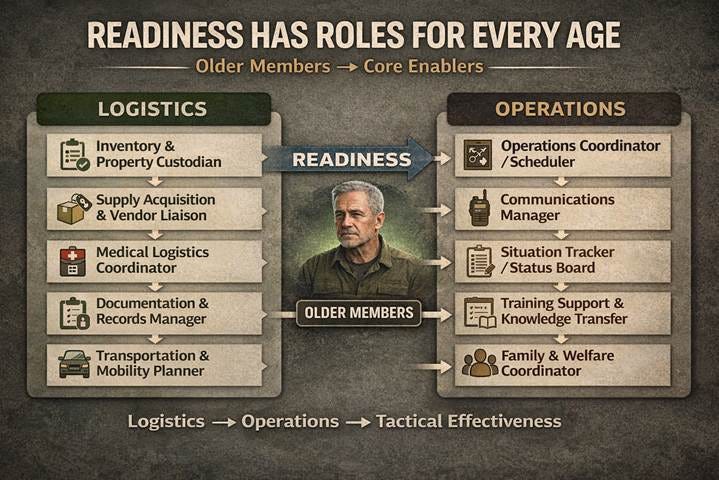
Why Readiness Is a Team Sport
True readiness is not about individual performance under stress. It is about coordination, sustainability, and decision-making under uncertainty. Logistics feeds operations. Operations enable tactical action. When any layer fails, the entire system degrades.
The Critical Role of Older Members
Older members bring judgment, pattern recognition, institutional memory and life experiences. They often have deeper community ties, stronger administrative skills, and a long-view understanding of risk. These attributes make them ideal for enabling roles that sustain readiness over time.
Logistics: The Foundation of Readiness
Logistics is where readiness either lives or dies. Inventory control, supply acquisition, medical logistics, documentation, and transportation planning are not glamorous — but they are decisive and necessary. Without disciplined logistics, operations collapse before they begin.
Operations: Turning Resources Into Action
Operations is the bridge between planning and execution. Scheduling, communications management, situation tracking, and knowledge transfer are force multipliers. These roles demand clarity, patience, and consistency — traits often strengthened with age.
Tactical Effectiveness Is the Outcome, Not the Starting Point
Too many preparedness cultures focus exclusively on tactical performance. But tactics are downstream of logistics and operations. When older members anchor the system at the logistics and operations layers, younger members are free to perform tactically — safely, legally, and effectively.
Readiness Is Inclusive by Design
A resilient readiness structure assigns roles based on capability, not age. Every household, group, or community benefits when experience is treated as a strategic asset. Preparedness becomes readiness only when roles are defined, practiced, and respected.
Final Thought
Readiness is not about who can run the fastest or lift the most. It is about who ensures the right resources are in the right place, at the right time, with the right information. Older members are not on the sidelines of readiness — they are at its core. They are valuable.
There are backup roles that must be taken care of . Thanks for sharing
Good points brother. Great article. Covers topics most people ignore or refuse to accept