


Most all readiness and preparedness minded individuals when asked “what’s most important”. The answer is almost always “Beans, Bullets and Band-aids”, but seldom does the conversation get past that point. Then when theses same readiness and preparedness minded folks are ask about “supplies”, most often it met with the comments about simply buying the necessary “stuff”. This is similar to conversations about the “high speed, low drag, tier one operator stuff”. Very little talk or consideration is given to training and becoming proficient with the “stuff”. I readily admit that I am one of those people. I truly love the all the tactically cool gear and equipment. I look forward to training to become an “operator”. Then reality sets in.
I am well past my prime to train to become an “operator” (as sad as that makes me). However, I am also a “realist”. I realize that I must and do train as often as possible to my levels of capabilities. I realize that being proficient with my weapons and gear is vitally important to my families safety and possibly existence. So I do it and believe everyone should train and train often. Whatever our capabilities and restrictions. I admit that I was guilty of thinking almost exclusively about “guns and gear” until I was watching a YouTube video. The video creator was recounting a visit to train at the range. He told the story of how once his and his buddy’s magazines “ran dry”. It became immediately and painfully clear that no one thought to bring extra ammunition. Each one them thought the other was bringing it. It was clear from the story that both were completely shocked and stunned about being without additional ammunition, etc. This was when it hit me. “Who responsible for getting, storing, issuing and resupplying my ammunition and other essential gear and supplies? This article is not a complete answer to those question, nor it is intended to be. It is simply written to make us all stop, think and hopefully keep any of us from saying “I thought you were bringing that”.
As mentioned above, when people think “preparedness/readiness,” they think and picture gear. But preparedness fails at the administrative level — long before the tactical gear matters. I have heard it said and seen it written that “logistics is the quiet backbone of any preparedness structure” and “nothing exist without it” (Logistics).
So preparedness is 80% administrative work: planning, documenting, tracking, maintaining, and organizing the systems that keep you/us functional before anything can happen or does goes wrong. And remember it is much more than “Beans, bullets and band-aids”. Again, please note, the discussion below is not expert advice just my opinion based on thought, research and conversations. Below is not a complete list of everything discussed below.
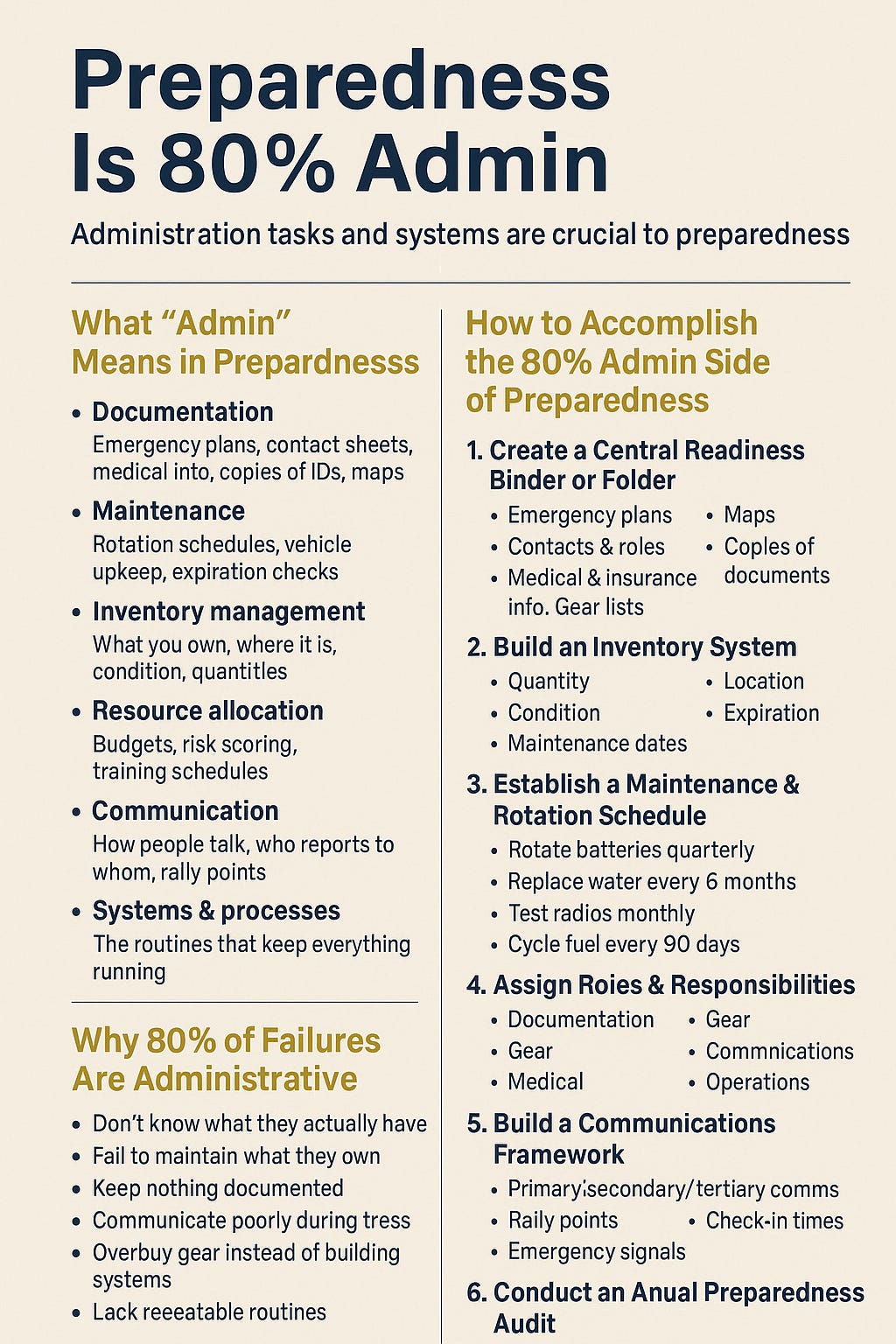
EXAMPLES OF ADMIN AND ADMIN SYSTEMS:
- Documentation: emergency plans, contact sheets, medical info, copies of IDs, maps
- Maintenance: rotation schedules, vehicle upkeep, expiration checks
- Inventory management: what you own, where it is, condition, quantities
- Resource allocation: budgets, risk scoring, training schedules
- Communication: how people talk, who reports to who, rally points
- Systems & processes: the routines that keep everything running
WHY 80% OF FAILURES ARE ADMINISTRATIVE:
- People don’t know what they have
- Gear is not maintained
- Nothing is documented
- Communication fails under stress
- Systems don’t exist or aren’t followed
HOW TO ACCOMPLISH THE 80% ADMIN SIDE:
1. Create a Readiness Binder or Folder
2. Build an Inventory System
3. Establish Maintenance & Rotation Schedules
4. Assign Roles & Responsibilities
5. Build a Communications Framework and Plans
6. Conduct an Quarterly, Semi-Annual or Annual Preparedness Audit
7. Create Daily/Weekly Admin Habits
80/20 FRAMEWORK:
- Logistics: 50%
- Operations: 30%
- Tactical: 20%
SUMMARY:
To sum this up, I believe that Preparedness is 80% administration “Admin”. Admin builds the backbone that makes true readiness/preparedness possible. While we can not all be “Operators” we must be as proficient as possible with the tools we have available. Whether that’s weapon, computer, radio, or pen and pencil there is a job and a place for everyone in the Readiness/Preparedness arena whether in a group or as individuals. Let me know your thoughts, comments and recommendations.
PS: if you cannot tell this is my first attempt at writing. I hope it was not too terrible.
Bobby Bama
Outstanding! I look forward to reading more!
Excellent , I’m going to share this !