


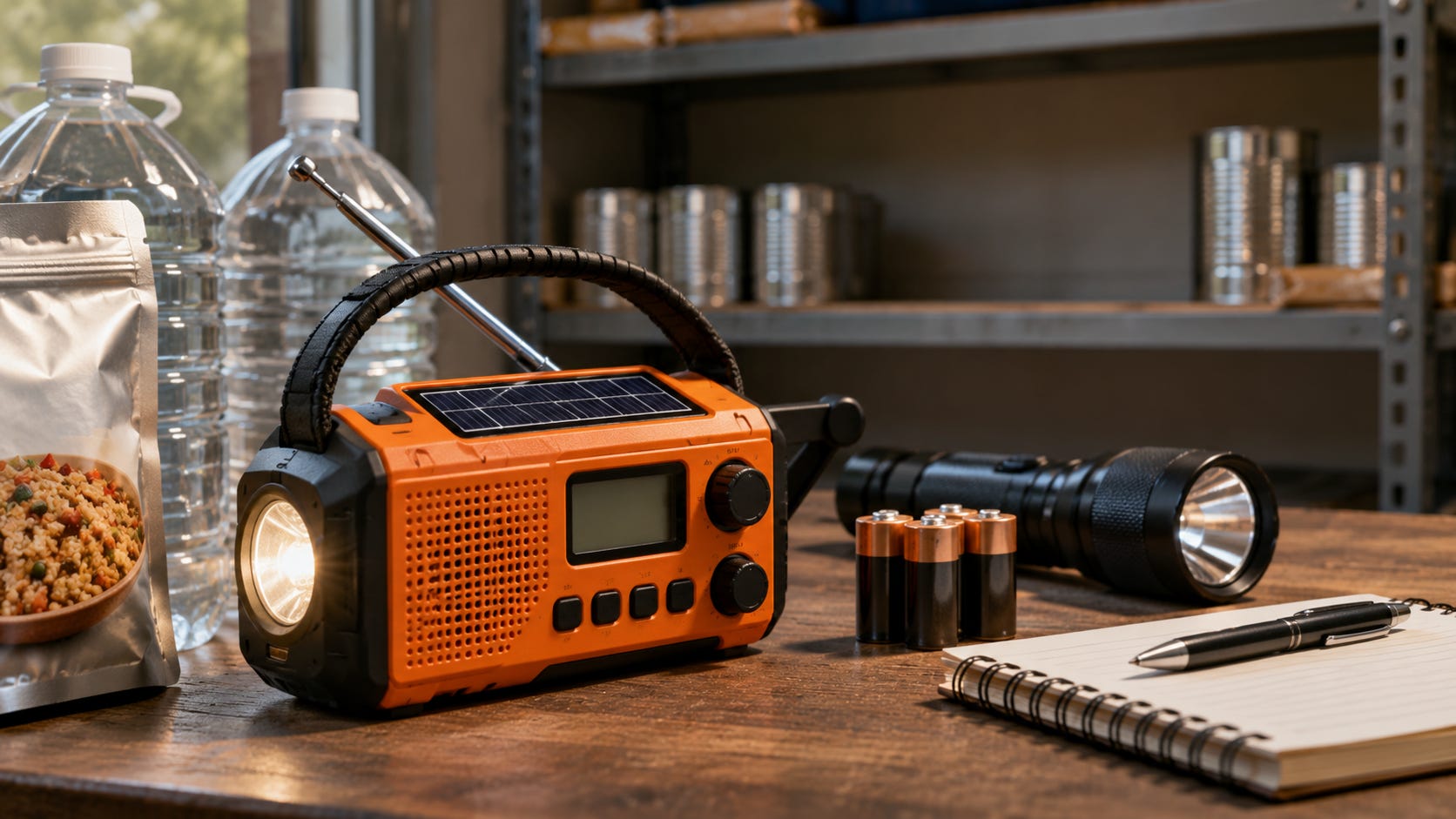
I wasn’t looking for evidence of some impending national emergency. I was looking for a hand-crank emergency radio.
Nothing particularly exciting about that.
I was browsing Amazon, looking at different radios, comparing features and prices, and trying to decide whether I really needed another piece of equipment.
Then I noticed something.
Several of the radios had delivery dates stretching into December. One wasn’t expected to arrive until sometime in January.
January?
Now, I’ve gotten pretty spoiled by Amazon. I’m accustomed to ordering something and having it show up at my door in a day or two. So seeing a six-to-eight-week wait for a little emergency radio caught my attention.
I wondered what was going on.
That got me thinking about some conversations I’ve been hearing lately concerning shortages of preparedness supplies. People have been talking about products being out of stock, unusually long delivery times, and certain items becoming harder to find.
Some of those conversations have been pretty reasonable. Others, well, not so much.
Anyway, I decided to do a little digging.
And I found a few things worth sharing.
Turns Out, There Are Some Shortages
At least with certain products.
For example, I checked the availability of Midland emergency weather radios.
Two major retailers, Crutchfield and B&H Photo, were showing selected models as unavailable.
The Midland ER310 was particularly interesting. Both retailers were indicating that replenishment might not occur until early February 2027.
That’s nearly three months away.
I also checked Mountain House, one of the better-known manufacturers of freeze-dried food.
Their website was showing numerous emergency food kits as sold out, including some of their larger 30-day, three-month, six-month, and one-year packages.
Now, that doesn’t mean there’s a nationwide shortage of food or emergency radios.
Other brands and retailers may have plenty available.
But there are clearly some products that aren’t as readily available as they normally might be.
What I wanted to know was whether there was something more to it.
Then I Came Across Something in South Carolina
On November 6, FOX Carolina reported that a preparedness retailer in Laurens County, South Carolina, was seeing a substantial increase in business.
The owner estimated sales had jumped somewhere around 60 to 70 percent.
That’s a pretty good increase.
He also reported that his inventory had been significantly depleted.
Apparently, much of the increased buying was connected to online stories about an impending 90-day nationwide blackout.
You may have seen some of those stories yourself.
The problem is that I haven’t found credible evidence supporting the claim that we’re about to experience a planned nationwide blackout.
But here’s what’s interesting.
Whether that story was true or not, people were apparently reacting to it by purchasing emergency supplies.
And when enough people do that at the same time, it’s entirely possible for stores to run out of certain products.
So we could have actual shortages caused, at least in part, by people responding to something that hasn’t been substantiated.
I found that worth thinking about.
There’s Something Similar Going On Overseas
In late October, following government emergency-preparedness messaging in the United Kingdom, retailers reported significant increases in sales of emergency supplies.
According to reporting in The Guardian, one retailer said sales of flashlights had nearly quadrupled. Radio and power-bank sales had roughly doubled.
Some emergency radio models sold out.
Apparently, people were paying attention to the government’s recommendations and buying things they thought they might need.
Nothing terribly surprising about that.
What interested me was that these purchasing increases weren’t necessarily accompanied by widespread shortages of ordinary groceries or other household necessities.
It seemed to be more concentrated in particular categories of emergency equipment and supplies.
Sound familiar?
So What’s Going On?
I wish I could give you a definitive answer.
I can’t.
It could simply be that more people are taking an interest in emergency preparedness.
It could be that manufacturers and retailers aren’t keeping enough inventory on hand to accommodate sudden increases in demand.
Some of these products are manufactured overseas, which introduces another set of possible explanations involving shipping, distribution, and replenishment.
And we’re heading into the holiday shopping season, which certainly doesn’t help delivery times.
Maybe several things are happening at once.
One thing I haven’t been able to establish is that we’re experiencing some widespread, nationwide shortage of preparedness supplies.
That doesn’t mean there isn’t a problem developing.
It just means I haven’t found enough information to reach that conclusion.
What I’m Going to Be Watching
I’m particularly interested in whether the availability problems continue or become more widespread.
For example, if a Midland radio is out of stock at one retailer, that doesn’t tell us much.
But when several retailers are reporting the same model unavailable, and their estimated replenishment dates stretch months into the future, that gets my attention.
I’d also be interested in seeing whether comparable radios from other manufacturers are becoming difficult to find.
The same goes for water filtration equipment, emergency food, batteries, and backup power supplies.
And then there’s pricing.
If something that normally sells for $50 suddenly starts showing up everywhere for $90, I’d be curious about that, too.
Of course, an inflated price on Amazon doesn’t necessarily tell us anything about the broader market. Some of those marketplace sellers can be pretty imaginative when it comes to pricing.
What I’d really like to know is whether several different retailers are experiencing the same problems at the same time.
That would tell us a little more.
It Also Got Me Thinking About My Own Supplies
While I was researching all this, I started thinking about some of the things I’ve been meaning to purchase or replace.
You know how that goes.
You notice something you need, make a mental note to get it, and then get busy doing something else.
Six months later, you’re still making that same mental note.
I’ve done that more times than I care to admit.
And that’s probably the one practical thing I’ll take away from all this.
There are a few items I’ve been putting off purchasing, and I probably ought to get around to addressing them.
Not because I’m convinced something terrible is about to happen.
Simply because I’ve already decided they’re things I need.
Of course, that doesn’t mean I’m going to rush out and buy everything on my wish list.
I have enough equipment sitting around here already that I occasionally have to remind myself what some of it was supposed to do.
But I am going to take another look at what I’ve got, what works, and what I actually need.
That seems reasonable enough.
Back to That Emergency Radio
After looking into all this, I’m still not convinced we’re experiencing a major nationwide shortage of preparedness supplies.
But I’m also not inclined to dismiss the availability problems that are being reported.
Some are clearly real.
Others need more investigation.
And I suspect we’ll learn more as we see whether these shortages persist or disappear over the next several weeks.
In the meantime, I’m going to keep an eye on things.
If I notice something unusual, I’ll look into it. And if I find something worth sharing, I’ll pass it along.
As for that hand-crank radio, I haven’t decided whether I’m going to order one.
I’m still comparing models.
And frankly, the more I look at them, the more I’m beginning to wonder whether I really need another emergency radio in the first place.
Which probably means I ought to sit down, get something cold to drink, and reconsider a few of my purchasing decisions.
But I’m curious about something.
Have any of you noticed preparedness supplies becoming harder to find?
I’m particularly interested in actual experiences. Products you’ve tried to order, unusual delivery dates, stores reporting items out of stock, or prices that seem to have increased substantially.
I’d like to hear what you’re seeing.
Maybe we’re looking at a few isolated inventory problems.
Maybe there’s something more developing.
I don’t know yet.
But it seems worth paying attention to.
— Bobby Bama
Sources and Further Reading
Retail inventory and delivery estimates are time-sensitive and may change.